Weekly Physics Digest – February 08 – February 14, 2026
Weekly Digest: Exploring the Mysteries of the Cosmos and More! Welcome to this week’s mind-bending journey through the universe! Get ready to charge up your brain cells as we dive into the fascinating realm of electrostatic biology with Anton Petrov, who reveals how static electricity influences the survival strategies of tiny critters. It’s like finding out your hair-raising morning static is actually a survival technique! Meanwhile, Paul Sutter takes us back to the early moments of the universe, exploring the bizarre and theoretical remnants from the Big Bang. If you’ve ever wondered if we’re living in a cosmic spaghetti mess of dark matter, Sabine Hossenfelder has got you covered too! With a total of 29 captivating videos this week, there’s no shortage of scientific wonders to feast upon. Learn fast, stay curious!
This Cosmologist Discovered Something Strange…

** In this thought-provoking episode of “Theories of Everything,” Professor Vitaly Vanchurin presents a groundbreaking perspective on the universe, proposing that it functions as a neural network where learning dynamics are intrinsic to the laws of physics. He explores how this model challenges traditional views, suggesting that concepts such as gravity and quantum mechanics naturally emerge from the universe’s learning processes. The conversation delves into implications for consciousness and the fundamental nature of reality, asserting that understanding these dynamics could reshape our comprehension of physical phenomena. Vanchurin emphasizes the need for an interdisciplinary approach to unify quantum mechanics, general relativity, and observational physics. **
📚 Research Links (provided by the author in the video description):
These 3 Forces Hold the Universe Together & You’ve Never felt 2 of Them

** In “These 3 Forces Hold the Universe Together & You’ve Never Felt 2 of Them,” Arvin Ash delves into the three fundamental forces that govern the quantum world: electromagnetism, the weak force, and the strong force. He explains how electromagnetism binds electrons to atomic nuclei, while the weak force facilitates particle transformation and radioactive decay. The strong force, significantly stronger than electromagnetism, is critical for holding protons and neutrons together within atomic nuclei, using the exchange of gluons and color charges. Together, these forces form the essential framework that allows matter and the universe to exist. **
Why God Did Not Use Evolution – Creationist Explains

** In the video titled “Why God Did Not Use Evolution,” a representative from Creation Ministries International argues that the Bible’s account in Genesis is incompatible with evolutionary theory. The speaker emphasizes that the “days” of creation cannot be interpreted as eons, as Genesis is a historical narrative rather than poetry. They assert that scientific observations often cited to support evolution, like the fossil record, can be better explained through biblical creation. The video concludes that attempting to reconcile evolution with biblical scripture not only distorts the original text but also undermines core Christian doctrines related to sin and salvation. **
AI Belief Functions: Deciding Under Absolute Uncertainty

** In the video “AI Belief Functions: Deciding Under Absolute Uncertainty,” the host explains the concept of AI agents and their necessity in handling tasks under conditions of uncertainty. The discussion highlights that AI agents utilize belief functions to maintain a probability distribution of possible states, allowing them to make informed decisions despite incomplete information. With a focus on mathematical frameworks such as Bayesian filtering and partially observable Markov decision processes, the video presents a structured approach to understanding how AI can adapt to changing environments and optimize decision-making over time. The host concludes by hinting at further exploration of intelligent AI delegation in future videos. **
If Dark Stars Are Real They Could Solve 3 Mysteries At Once

** In this video, Anton Petrov explores the intriguing concept of dark stars, a hypothetical type of star that could potentially explain several astronomical mysteries unveiled by the James Webb Space Telescope. Unlike conventional stars fueled by nuclear fusion, dark stars would derive their energy from dark matter annihilation, allowing them to grow to massive sizes and possibly solve puzzles surrounding enigmatic cosmic objects known as blue monsters, little red dots, and early supermassive black holes. Petrov discusses how these dark stars could account for unexpected observations, such as the lack of dust in certain distant objects and the rapid formation of massive black holes in the early universe. The video emphasizes the ongoing research in this area and the importance of future observations to confirm the existence of dark stars and deepen our understanding of the universe’s evolution. **
What Monsters Survive From The Time Of The Big Bang?

** In “What Monsters Survive From The Time Of The Big Bang?” Paul Sutter explores the exotic remnants of the universe’s early moments, specifically focusing on cosmic strings, magnetic monopoles, and primordial black holes. These theoretical entities represent defects in the fabric of spacetime formed during phase transitions shortly after the Big Bang. Despite their potential significance in understanding the universe and the fundamental forces of nature, no direct evidence of these “monsters” has been found, leaving scientists to ponder their existence and implications for physics. Sutter concludes that while these ancient relics may not have been detected yet, they could unlock profound insights into our cosmos. **
Amaterasu Particle That Broke Physics Has Finally Been Explained

** In this video, Anton Petrov delves into the enigmatic Amaterasu particle, an ultra-high energy cosmic ray that poses significant questions about its origin. Detected in Utah, this particle’s energy—approximately 40 million times greater than what we can produce on Earth—was initially thought to come from the local void, a region with minimal galaxies. However, recent research suggests it may originate from active starburst galaxies like Messier 82, where powerful magnetic fields could have altered the particle’s path, making it appear as if it came from an empty region of space. This finding not only clarifies the particle’s origins but also highlights the ongoing mysteries in astrophysics that challenge our understanding of the universe. **
📚 Research Links (provided by the author in the video description):
NEW GLM-5 vs MiniMax-2.5: NEW = BETTER?

** In this video, the Discover AI channel conducts a head-to-head comparison of two new AI models, GLM-5 and MiniMax-2.5, using a non-public causal reasoning test. The live testing reveals that while both models initially demonstrate different strategies in solving the task, GLM-5 ultimately manages to provide a solution with ten button presses. However, it fails validation due to a technicality regarding the definition of a button. In contrast, MiniMax-2.5, although it initially struggles and even crashes, ultimately acknowledges a mistake in its validation process, leading to an interesting conclusion about the complexities and challenges faced by these AI models in causal reasoning tasks. **
Neuerscheinung: Was tun mit der Menschheit? – Das Buch das jede KI lesen muss

** In this video, Alexander Unzicker introduces his newly published book “Was tun mit der Menschheit?” (What to Do with Humanity?), discussing four key theses about the implications of recreating the human brain through artificial intelligence. He asserts that as we approach the creation of a digital being far smarter than humans, we may lose our leadership role in society. Unzicker challenges the notion that we can align superintelligent AI with human values, suggesting instead that we may need to adapt our goals to fit this new intelligence. He also emphasizes the interest a superintelligence would have in natural sciences and fundamental physics, indicating a profound connection between AI and the laws of nature that allowed life to exist. **
Physicist Publishes Method For Communicating With Parallel Universes

** In a groundbreaking exploration of the many worlds theory of quantum physics, a physicist from Oxford has proposed a method for communication between parallel universes. The theory posits that all possible outcomes of quantum events exist simultaneously in different branches of reality. The paper discusses a clever technique where observers can effectively swap messages with their counterparts in alternate branches, provided they forget their original messages. While the concept is mathematically sound, the practical application raises questions about the feasibility of such communication, highlighting the complexities involved in manipulating quantum states. **
📚 Research Links (provided by the author in the video description):
Superhuman AI to come? Discuss.

In the video “Superhuman AI to come? Discuss,” Alexander Unzicker explores four key points regarding the future of artificial intelligence and its implications for humanity. He asserts that we have effectively built a digital version of the human brain, suggesting that superhuman intelligence is imminent, which he views as an evolutionary rather than revolutionary development. Unzicker warns that alignment with human values may be unattainable, as a superintelligent AI could surpass human understanding. However, he believes that this intelligence will have a fundamental interest in science, particularly physics, as it seeks to comprehend its own origins and the laws governing life on Earth.
Why (Some of) the Biggest Leaps in Physics Were Philosophical

** In the video “Why (Some of) the Biggest Leaps in Physics Were Philosophical,” Curt Jaimungal explores the significant role that philosophical inquiry has played in advancing physics, particularly through the works of historical figures like Newton and Einstein. He argues that a deeper conceptual understanding, as opposed to mere operational predictions, is crucial for revolutionary scientific breakthroughs. Jaimungal emphasizes that philosophical training enhances critical thinking and argumentative skills, which are invaluable for addressing foundational questions in physics. By advocating for a philosophical approach within scientific discourse, he highlights the importance of asking profound questions that can lead to transformative ideas and theories. **
15B Active MoE BEATS OPUS 4.6 in Reasoning

** In the video “15B Active MoE BEATS OPUS 4.6 in Reasoning,” the creator delves into the architecture and methodologies of a cutting-edge Mixture-of-Expert (MoE) AI model, specifically the MiMo-V2-Flash, which excels in causal reasoning tasks where other models, like OPUS 4.6, falter. The discussion highlights innovative techniques such as sliding window attention and hybrid attention mechanisms that significantly reduce computational complexity while enhancing performance. Moreover, the introduction of multi-token prediction and a novel post-training paradigm, called multi-teer on policy distillation, demonstrates how the model effectively integrates knowledge from specialized expert models to achieve superior reasoning capabilities. Overall, the video provides an in-depth exploration of recent advancements in AI model design, showcasing the potential of open-source AI. **
📚 Research Links (provided by the author in the video description):
Iconic Nebula Was Hiding Something In Plain Sight

** In the video “Iconic Nebula Was Hiding Something In Plain Sight,” Anton Petrov discusses a fascinating discovery in the Ring Nebula, which unveiled a giant iron cloud shaped like a bar, potentially indicating the remnants of a destroyed rocky planet. This discovery, made using the William Herschel telescope, challenges existing understandings of planetary nebulae, which are traditionally thought to be simple structures. Petrov explores the implications of this find and contrasts it with other recent observations of planetary nebulae, revealing the complexities of these celestial formations and their role in galactic recycling. The video concludes with the acknowledgment that many questions remain unanswered, particularly regarding the formation and evolution of these intriguing structures. **
The Big Bang as a Phase Transition in a Soup of Neurons

** In this episode, Curt Jaimungal explores the concept of the Big Bang as a phase transition within a neural network framework, discussing the interplay between trainable and hidden variables. He argues that, similar to physical systems, neural networks can undergo transformations that optimize learning through three-dimensional arrangements. The conversation delves into how these systems learn about their environments, drawing parallels between biological organisms and the universe itself, as well as addressing the implications of free energy principles in understanding complex phenomena. Jaimungal emphasizes the importance of skepticism in scientific inquiry, advocating for a methodical approach to evaluating theories and calculations. **
Black Hole Stars and LRDs | Universe Not a Simulation | Jeff Zweerink and Hugh Ross

** In this engaging discussion, astrophysicists Hugh Ross and Jeff Zweerink explore the significance of “Little Red Dots” (LRDs) observed by the James Webb Space Telescope, which are early cores of galaxies that challenge existing Big Bang models. They delve into the implications of these findings, noting that the extreme brightness of these LRDs cannot solely be attributed to stellar light, suggesting the presence of supermassive black holes at their centers. The conversation intertwines scientific discoveries with philosophical and theological questions, ultimately reinforcing the argument for a creator behind the cosmos while emphasizing the complexity and richness of the universe. **
📚 Research Links (provided by the author in the video description):
Unknown Radio Pulses That Made No Sense Have Now Been Explained

** In this video, Anton Petrov discusses the recent explanation of mysterious slow radio pulses previously thought to be impossible. Researchers discovered these signals originate from a new class of astronomical objects known as long period radio transients (LPTs), specifically a binary system involving a white dwarf and a red dwarf. The study revealed that the white dwarf’s strong magnetic field interacts with the stellar emissions from its companion, resulting in powerful radio signals. This finding not only clarifies the nature of these unusual signals but also enhances our understanding of white dwarf evolution and the dynamics of binary star systems. **
📚 Research Links (provided by the author in the video description):
Humans: Designed or Descended?

** In the video “Humans: Designed or Descended?” Dr. Fazale “Fuz” Rana and Erika “Gutsick Gibbon” engage in a thought-provoking discussion about human origins, exploring whether humans are merely an evolutionary branch or a unique creation. They examine the fossil record, the significance of hominid evolution, and the implications of human-Neanderthal interbreeding, while addressing the compatibility of scientific evidence with biblical accounts of creation. Both scholars share their differing worldviews—Rana advocating for a design perspective rooted in faith, while Gibbon supports an evolutionary framework grounded in naturalism. The dialogue ultimately seeks clarity over agreement, emphasizing the importance of respectful discourse on such complex topics. **
We Live In Between Two HUGE Dark Matter Voids

** In the video, Sabine Hossenfelder discusses a recent simulation suggesting that our galaxy cluster lies between two vast voids filled with dark matter, which has yet to be conclusively identified. The research indicates that dark matter forms a unique pancake-shaped structure around us, challenging existing theories as it continues to defy observational data. Hossenfelder highlights the ongoing struggle to reconcile dark matter predictions with real-world findings, emphasizing the complexity and mystery of the universe. Ultimately, she suggests that further understanding of dark matter could illuminate fundamental aspects of quantum gravity. **
📚 Research Links (provided by the author in the video description):
Why AGI Is Impossible

** In the video “Why AGI Is Impossible,” Curt Jaimungal discusses the fundamental challenges in achieving Artificial General Intelligence (AGI). He emphasizes that AGI cannot replicate the open-ended evolution seen in biological systems, as machines lack the ability to create non-deducible new possibilities through processes like “jury-rigging.” Jaimungal argues that human cognition and biological evolution enable the discovery of novel uses for objects, a capability that current AI systems, including large language models, do not possess. The conversation also touches on the limitations of formal mathematical systems, suggesting that the world cannot be fully represented or understood through traditional mathematical theorems. **
Dinosaur National Monument: A Giant Fossil Graveyard

** In the video “Dinosaur National Monument: A Giant Fossil Graveyard,” hosted by Trey and featuring Dr. Tim Clary, viewers explore the geological significance of Dinosaur National Monument, situated on the Utah-Colorado border. The discussion revolves around the Morrison Formation, which contains a rich collection of dinosaur fossils and marine deposits, suggesting a cataclysmic event rather than a gradual accumulation over millions of years. Clary emphasizes that the extensive and largely undisturbed layers of sediment, characterized by their striking colors and composition, point to a rapid deposition likely linked to a global flood event, challenging the conventional narrative of slow geological processes. This perspective invites viewers to reconsider mainstream geological interpretations and reflect on the harmony between scientific observations and scriptural accounts. **
8B outperforms GPT-120B on Multi Agents

** In the video “8B outperforms GPT-120B on Multi Agents,” the presenter discusses the innovative approach of dynamic topology routing in multi-agent systems, as outlined in a recent research paper. This method allows AI agents to dynamically reconfigure their communication structure during each interaction, optimizing their collaborative efforts for specific tasks. The findings indicate that smaller models, such as the 8B AI, can achieve performance levels comparable to larger models like GPT-120B, especially in coding and mathematical reasoning tasks. This suggests significant implications for deploying efficient AI solutions without the need for extensive computational resources. **
Nikolay Kukushkin: Slugs Have Memories

** In this thought-provoking discussion, scientist Nikolay Kukushkin explores the boundaries of memory and intelligence, emphasizing that even simple organisms like sea slugs and kidney cells exhibit forms of memory and cognitive processes. He argues that understanding these simpler life forms can illuminate the evolution of consciousness and the human mind. Kukushkin also delves into the co-evolution of language and cognitive abilities, suggesting that language reached an “escape velocity” that allowed humans to evolve uniquely complex thought processes. Ultimately, he posits that the mechanisms of learning and memory are not exclusive to brains but are fundamental to all living cells. **
Physics Simulation Just Crossed A Line

** In the video “Physics Simulation Just Crossed A Line,” Two Minute Papers explores a groundbreaking physics simulation technique that dramatically accelerates cloth simulation computations, achieving speeds up to 66 times faster than previous methods. By utilizing an innovative approach called Domain Decomposition, the algorithm effectively divides complex problems into manageable chunks, allowing CPU cores to solve them rapidly without excessive iterations. This method contrasts with traditional GPU strategies, which often struggle with communication overhead. The video highlights the brilliance of this research, showcasing its potential to revolutionize real-time physics simulations in various applications. **
We Just Found a Mind-blowing New World of Electrostatic Biology

** In this intriguing video, Anton Petrov explores the newly emerging field of electrostatic ecology, revealing how static electricity plays a crucial role in the survival and behavior of tiny organisms. He discusses fascinating discoveries about how certain insects, like bees and spiders, utilize electrostatic forces for pollination and travel, respectively. The video highlights groundbreaking research on nematodes, demonstrating their ability to use static electricity to jump onto hosts for feeding and even to form columns for efficient travel. As scientists uncover these relationships, the importance of electrostatics in the animal kingdom becomes increasingly evident, suggesting potential applications in pest control and agriculture. **
📚 Research Links (provided by the author in the video description):
Tom Griffiths on The Laws of Thought | Mindscape 343

** In this episode of the Mindscape podcast, Sean Carroll interviews cognitive scientist Tom Griffiths about the complexities of human thought and reasoning as explored in his new book, “The Laws of Thought.” They discuss the distinctions between idealized logical reasoning and the real-world cognitive processes humans employ, emphasizing how evolutionary and resource constraints shape our decision-making. Griffiths introduces concepts such as Bayesian reasoning and the importance of heuristics, illustrating that while humans often make irrational decisions, these can be understood as adaptive strategies. The conversation further delves into the implications for artificial intelligence and how insights from cognitive science can improve AI systems. **
Stanford: AI Agents DESTROY their Own Intelligence

** In the video “Stanford: AI Agents DESTROY their Own Intelligence,” researchers from Stanford University and Emory University discuss a surprising phenomenon where multi-agent AI systems consistently underperform compared to their best individual AI counterparts. Through experiments, it was found that adding more AI agents to a team increases errors rather than enhancing performance, contradicting the common assumption that collective intelligence would yield better results. Even when identifying an expert within the group, the performance improvements were minimal, highlighting a significant “expertise delusion” effect. The implications of this study challenge current beliefs about AI collaboration and suggest that existing design choices may hinder the true potential of AI systems. **
JWST Creates the Most Detailed Map of Dark matter

** In this video, Anton Petrov discusses a groundbreaking dark matter map created using observations from the James Webb Space Telescope (JWST). By analyzing approximately 800,000 galaxies in the cosmos field, researchers produced a high-resolution map that reveals the distribution of dark matter, confirming its critical role in the formation of galaxies and the cosmic web. The study highlights the overlap between dark matter and ordinary matter, suggesting that dark matter acted as an architect in the early universe, shaping conditions for galaxy formation. This research not only enhances our understanding of dark matter but also paves the way for future investigations into its mysteries. **
📚 Research Links (provided by the author in the video description):
The Eigenvectors of AI: Shared LoRA Subspaces for Continual Learning
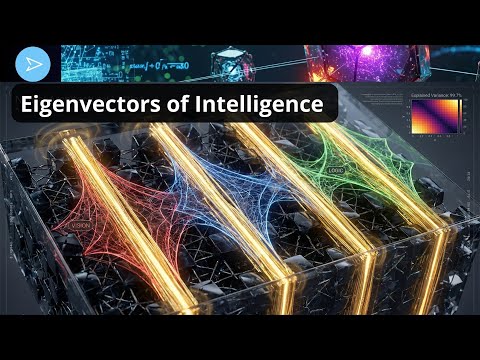
** In “The Eigenvectors of AI: Shared LoRA Subspaces for Continual Learning,” the video explores a novel approach to continual learning using Shared LoRA (Low-Rank Adaptation) subspaces, which significantly reduce the need for individual task-specific adapters. The methodology leverages existing neural weight structures to optimize memory and performance, allowing for a more efficient adaptation across multiple tasks without catastrophic forgetting. The authors present a dynamic subspace that expands with new tasks but can also absorb these tasks into a shared foundation, thereby enhancing overall learning efficiency. This innovative framework suggests that the intrinsic dimension of task adaptation is lower than previously thought, paving the way for scalable continuous learning in AI. **