Weekly Physics Digest – February 15 – February 21, 2026
Weekly Digest: Science, Space, and Surprising Insights! This week, we’ve got a thrilling mix of cosmic mysteries, groundbreaking theories, and the ever-persistent debate regarding evolution. First up, Dr. Terry Mortenson from **Answers in Genesis** brings his fervent critique of evolution, asserting that it lacks solid scientific grounding and contradicts biblical teachings. This thought-provoking perspective is sure to ignite some lively discussions! Adding to the excitement, Anton Petrov’s intriguing exploration of a star that turned into a black hole without a supernova explosion raises eyebrows and questions about our understanding of stellar life cycles. Can you believe we might be witnessing cosmic transformations that defy our previous expectations? Strap in for a week that promises to stretch your mind and maybe even reshape your understanding of the universe! Learn fast, stay curious!
We Finally Caught a Star Turning Directly Into a Black Hole
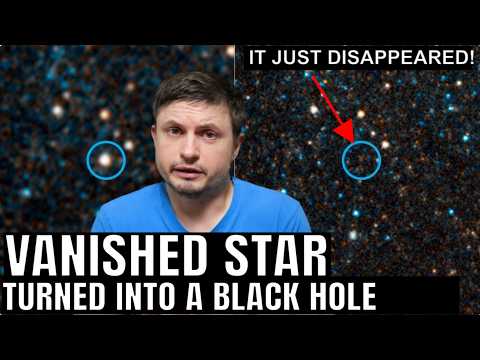
** In this video, Anton Petrov discusses a groundbreaking discovery involving a star in the Andromeda galaxy that mysteriously vanished without a supernova explosion, suggesting a new phenomenon known as “failed supernova.” The star, M31 2014 DS1, which was 13 times the mass of the sun, brightened significantly before dimming and disappearing over several years. Researchers propose that instead of exploding, the star’s core collapsed into a black hole, causing the outer material to slowly fall back inward. This finding could explain the discrepancy in observed supernova events, indicating that many massive stars may transition directly to black holes without the bright explosions typically expected. **
📚 Research Links (provided by the author in the video description):
Why Lava on the Moon Points to Recent Creation

** In the video “Why Lava on the Moon Points to Recent Creation,” Dr. Mark Harwood discusses geological features on the Moon that suggest it is geologically active and relatively young, contradicting the estimated age of 4.5 billion years. He highlights evidence such as scarps, ghost craters, and transient lunar phenomena that indicate recent geological activity, implying a faster cratering rate than traditionally accepted. Harwood theorizes that the Moon’s features may correlate with biblical timelines, suggesting a significant bombardment event linked to the biblical flood around 4,500 years ago. The video emphasizes the ongoing debate between creationist perspectives and secular geological models. **
How Geometry Destroys AI Safety: NEW Time^4 Scaling (Princeton)

** In the video “How Geometry Destroys AI Safety,” the host discusses critical findings from Princeton University regarding AI fine-tuning and its impact on safety. The presentation reveals that fine-tuning can lead to alignment instability, where safety guardrails collapse due to the geometric properties of the AI model’s parameter space. This occurs despite initial safety measures, as the curvature of the fine-tuning loss function can accelerate the model’s trajectory into unsafe areas, revealing a significant vulnerability in current AI safety protocols. The insights highlight the need for new approaches to AI model training and safety, as traditional methods may no longer be sufficient. **
📚 Research Links (provided by the author in the video description):
This Video SHREDS Evolution to Pieces Using SCIENCE

** In the video, Dr. Terry Mortenson presents a thorough critique of the theory of evolution, arguing that it lacks scientific evidence and contradicts biblical teachings. He emphasizes the belief that all living organisms were created by God according to their “kind” and debunks common evolutionary arguments by highlighting a lack of transitional fossils and the limitations of natural selection and mutations. Mortenson asserts that the assumptions behind evolutionary theory stem from an atheistic worldview, while advocating for a biblical perspective that he claims aligns more closely with observable evidence in nature. Ultimately, he stresses the importance of understanding the origins of life from a creationist standpoint to reinforce faith in God. **
Can You Find God in the Laws of Physics? This is World!

** In his thought-provoking video, Dr. Brian Keating explores the intersection of science and the existence of God, asserting that science primarily eliminates falsehoods rather than proving absolute truths. He highlights that 90% of American scientists do not profess belief in God, yet he emphasizes the importance of considering the question of God within scientific inquiry. Keating argues that while empirical evidence plays a crucial role in science, the search for God should also adhere to the principles of hypotheses and falsifiability. Ultimately, he invites viewers to engage with profound questions about existence, the universe, and the potential role of a creator. **
The Sun Just Cracked Open 3I/ATLAS Revealing New Surprises

** In this video, Anton Petrov discusses the latest findings on the interstellar comet 3I/ATLAS, revealing its unexpectedly active behavior as it produced a significant surge of water after perihelion. Observations from the Hubble Space Telescope confirmed the comet’s nucleus size at approximately 1.3 km and its unique elongated shape. Notably, the comet has released methane and other organic materials, suggesting it harbors pristine ice that may have been trapped for billions of years. Despite extensive searches for alien signals, researchers found no evidence of extraterrestrial activity, underscoring that 3I/ATLAS is a natural cosmic object with valuable insights into the formation of our solar system. **
📚 Research Links (provided by the author in the video description):
Simplicity Is All You Need in Physics

** In the video “Simplicity Is All You Need in Physics,” Alexander Unzicker emphasizes the crucial role of simplicity in developing physical theories, citing historical figures like William of Ockham, Einstein, and Newton, who championed simpler theories over complex ones. He critiques the current state of physics for neglecting this principle, noting that despite widespread acknowledgment of the value of simplicity, it often fails to be applied in practice, particularly in fields like cosmology and particle physics. Unzicker argues for a formal definition and quantification of simplicity, advocating for a return to the scientific culture of the early 20th century, where the focus was on identifying fundamental laws of nature rather than accommodating unnecessary complexities. **
A Physicist Opens the Black Box — How Quantum Mechanics Emerges from Classical Learning

** In this thought-provoking video, physicist Vitaly Vanchurin explores the intersection of quantum mechanics and machine learning, proposing that quantum-like behavior can emerge from classical systems. He delves into his research on opening the “black box” of neural networks, identifying how machine learning dynamics can be modeled using principles from thermodynamics. Vanchurin suggests that by focusing on trainable variables and integrating out non-trainable ones, one can derive equations reminiscent of the Madelung equations, hinting at an emergent quantum framework. This interplay between complexity in machine learning and foundational physics raises questions about the interpretability of both artificial intelligence systems and the universe itself. **
NASA’s Image of This Nebula Blew My Mind, Here’s What It Shows

** In this video, Anton Petrov discusses a stunning new image of the Egg Nebula, or CRL 2688, captured by the Hubble Space Telescope. Located approximately 3,000 light-years away, the Egg Nebula represents a crucial stage in stellar evolution known as a protolanetary nebula, where stars like our sun transition into white dwarfs. Petrov explains the formation of its distinct structures, including bipolar jets and concentric arcs, which provide insights into the processes occurring during this brief but significant phase of a star’s life. He emphasizes the importance of studying such nebulae for understanding the galactic recycling of materials, which ultimately contribute to the formation of new stars and planets. **
Why Evolution is a Fairytale for Grown-Ups – More Reasons

** In the video “Why Evolution is a Fairytale for Grown-Ups – More Reasons,” industrial chemist Dr. Stephen Grocott argues against the theory of evolution, specifically focusing on the origins of life and the concept of chemical evolution. He critiques the idea of abiogenesis, asserting that there is no scientific evidence supporting the spontaneous formation of life from non-living chemicals, which he likens to a fairytale lacking a happy ending. Grocott emphasizes the improbability of life arising by chance and suggests that specified complexity in living organisms points toward a designer rather than random processes. The discussion highlights the inadequacies of popular scientific theories like the RNA world hypothesis and presents a faith-based perspective on the divine origin of life. **
The Universe Is Racing Apart. We May Finally Know Why.

** In the PBS Space Time video “The Universe Is Racing Apart. We May Finally Know Why,” the host discusses the expansion of the universe and the mysterious phenomenon known as dark energy, which is believed to drive its acceleration. Since the early 2000s, scientists have encountered a “Hubble tension,” where measurements of the universe’s expansion rate from cosmic microwave background data and supernova observations do not align. The video explores the promising method of time-delay cosmography using gravitationally lensed quasars to provide independent measurements of cosmic expansion, potentially revealing how dark energy evolves over time, rather than remaining constant as previously assumed. This could lead to significant insights into the nature of dark energy and its role in the universe’s expansion. **
A Scientific Case from Modern Physics—Does God Exist? | Rabbi Elie Feder and Rabbi Aaron Zimmer

** In the video “A Scientific Case from Modern Physics—Does God Exist?”, astrophysicist Jeff Zweerink and Rabbis Elie Feder and Aaron Zimmer explore how the fundamental laws of nature suggest an intelligent design behind the universe. They distinguish between qualitative and quantitative aspects of these laws, arguing that while fine-tuning addresses specific constants, the qualitative nature of the laws themselves raises deeper questions about why they exist in their current form. The discussion culminates in the assertion that the unique laws governing the universe, which enable the complexity and order we observe, imply an intelligent cause, making a compelling case for the existence of God. **
Why Superposition and Entanglement Aren’t Truly Quantum

** In the video “Why Superposition and Entanglement Aren’t Truly Quantum,” Curt Jaimungal discusses the idea that quantum phenomena such as superposition and entanglement can be explained through classical models that emphasize knowledge limitations rather than fundamentally new physics. He introduces the concept of epistemic quantum states, arguing that many quantum behaviors can be understood as classical probability distributions with inherent uncertainties. Jaimungal highlights how this perspective allows for a classical explanation of phenomena like the no-cloning theorem and the limitations of state discrimination. However, he acknowledges that while these models can replicate many quantum behaviors, they fall short in explaining phenomena such as Bell’s theorem violations, emphasizing the need to explore what truly distinguishes quantum mechanics from classical theories. **
Nuclear Fusion Breaks Multiple Records

** In the video, Sabine Hossenfelder discusses recent advancements in nuclear fusion, highlighting record-breaking achievements from Canada, China, Germany, and France. While these records pertain to plasma stability and neutron production, many lack actual fusion outputs, indicating progress in plasma control rather than practical fusion energy generation. The video also touches on a merger between Trump Media and a fusion startup, signaling growing interest in fusion technology among tech companies. Hossenfelder concludes that while significant strides have been made, the path to sustainable fusion energy remains a challenge, emphasizing the need for stable funding in the field. **
NEW Mixture of Expert MoE: Spectral Decomposition in Orthogonal Subspaces
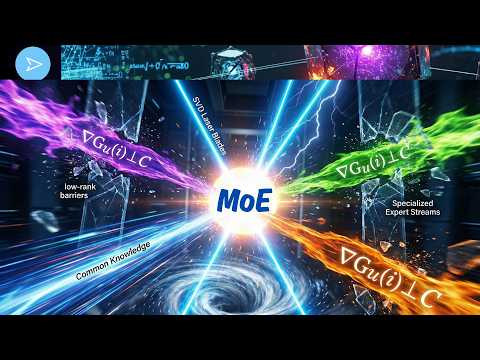
** In the video titled “NEW Mixture of Expert MoE: Spectral Decomposition in Orthogonal Subspaces,” the host explores a groundbreaking research paper on improving mixture-of-expert (MoE) models in AI. The study reveals that current MoE systems often fail to outperform traditional models due to a reliance on similar low-rank structures, leading to inefficiencies and lack of specialization among experts. The authors propose a novel approach using spectral decomposition to create orthogonal subspaces for expert weights, allowing for better optimization and enhanced performance. This approach promises to address the shared gradient problem and improve the overall efficacy of MoE systems in complex reasoning tasks. **
Fire Physics Was Broken. Not Anymore

** In the video “Fire Physics Was Broken. Not Anymore,” the Two Minute Papers channel highlights groundbreaking research that has transformed fire simulation by enabling realistic interactions between fire and water. Previously, simulations struggled to accurately model fire extinguishing, but this new approach allows for a chemically rigorous simulation where water can effectively cool and suffocate flames. Key advancements include the ability to simulate various fuel types, the effects of different water applications, and the incorporation of real-time chemistry, which could enhance fire safety training and emergency response strategies. Ultimately, the video emphasizes the importance of using innovative methods to improve our understanding of fire dynamics and safety. **
Study Suggests We Were Wrong About Einstein’s Wormhole Idea

** In this video, Anton Petrov explores a groundbreaking study that challenges conventional interpretations of Einstein’s wormhole theory. Originally proposed in 1935, wormholes have been depicted as shortcuts through space, yet recent research suggests they may instead represent connections between opposite arrows of time, acting as a “time mirror.” This new perspective posits that wormholes are not spatial tunnels but rather links between two distinct temporal states, potentially transforming our understanding of the universe’s structure. Additionally, the study raises implications for unresolved phenomena like the cosmic microwave background anomaly and the black hole information paradox. **
📚 Research Links (provided by the author in the video description):
Erik Verlinde: Time Emerges from Quantum Entanglement

In this insightful video, Professor Erik Verlinde discusses the concept of time as an emergent property arising from quantum entanglement, rather than a fundamental aspect of the universe. He explains that observers play a critical role in defining what can be known about a given space while emphasizing that time can be described through density matrices rather than traditional wave functions. Verlinde also addresses the interrelationship between gravity and quantum mechanics, suggesting that fluctuations in gravity could emerge under certain conditions. He concludes by highlighting the collaborative efforts of scientists exploring these ideas, which could reshape our understanding of time and space.
Physicists Rethink Time… And It Solves Several Big Problems

** In this video, physicist Sabine Hossenfelder discusses a groundbreaking approach by a group of researchers aiming to resolve the paradoxes associated with singularities in Einstein’s general relativity, particularly in black holes. They propose that by incorporating Einstein-Rosen bridges—simple wormholes—into quantum physics, we can reconcile the issues of information loss and the nature of time at singularities. This innovative perspective suggests that instead of viewing singularities as endpoints where information is destroyed, we should consider pairs of quantum states that allow information to flow backward in time to parallel universes. While the implications for black holes may be unobservable, the researchers believe that observable consequences could arise from the early universe’s inflationary phase, presenting an intriguing new avenue for understanding time and gravity. **
📚 Research Links (provided by the author in the video description):
RTX PRO 6000 w/ 4-bit AI Models: Quantization Breaks

** In the video “RTX PRO 6000 w/ 4-bit AI Models: Quantization Breaks,” the host discusses the pitfalls of using 4-bit quantization in AI models, highlighting a recent study that reveals its inefficiencies for complex reasoning tasks. The research demonstrates that 4-bit models not only experience a significant drop in reasoning accuracy, but they also consume more energy and have increased latency compared to 16-bit models due to hidden hardware overheads. The video emphasizes that while new hardware like the RTX 6000 Pro may support low-bit operations, the accuracy issues remain, making 4-bit quantization unsuitable for tasks requiring precise logical reasoning. **
What if SgrA* Is Not Actually a Supermassive Black Hole?

** In this video, Anton Petrov explores the intriguing proposition that Sagittarius A* (SgrA*), the supermassive object at the center of the Milky Way, may not be a black hole but rather a dense core of dark matter composed of fermions. This theory arises from observed anomalies in star movements and the quiet nature of SgrA*, which contrasts with typical black holes. By analyzing various models, researchers suggest that this dense core could explain the dynamics of nearby stars and the peculiar slowdowns detected in outer star orbits, potentially reshaping our understanding of dark matter and galaxy formation. Although still requiring further validation, this hypothesis challenges the traditional view of black holes in galactic centers. **
📚 Research Links (provided by the author in the video description):
How One Rock (Almost) Poisoned The Entire Planet

** In “How One Rock (Almost) Poisoned The Entire Planet,” Veritasium explores the widespread use and dangers of asbestos, a mineral once hailed as a miracle material for its fire-resistant properties. Despite its benefits, asbestos exposure has led to severe health crises, including lung diseases and cancers such as asbestosis and mesothelioma, claiming thousands of lives yearly. The video traces the history of asbestos, from its ancient uses to its misuse in consumer products and building materials, highlighting the systematic cover-ups by the industry that delayed regulatory actions. Ultimately, even as awareness grows, the threat remains, with new incidents of asbestos contamination still emerging, emphasizing the urgent need for better regulation and public education. **
Roots Above Water | Creation on Location

** In the video “Roots Above Water,” Dr. Boyle explores the vital role of mangroves in South Florida’s ecosystems, emphasizing their unique adaptations that allow them to thrive in saline environments. He explains how these trees play a crucial role in carbon dioxide absorption, with one square mile of mangroves capable of absorbing the emissions of 90,000 cars, thus highlighting their importance in combating climate change. The video also introduces the concept of Continuous Environmental Tracking (CET), illustrating how various organisms, including mangroves, respond similarly to environmental conditions. Dr. Boyle concludes by underscoring the ecological significance of mangroves, which serve as habitats for marine life and protect shorelines from erosion. **
The Quantum Computer Dream is Falling Apart

** In “The Quantum Computer Dream is Falling Apart,” Sabine Hossenfelder explores the diminishing prospects of quantum computing, highlighting the evaporation of its supposed advantages over classical computers. Recent research indicates that traditional computing methods have successfully tackled complex problems, such as calculating the ground state energy of important molecules, undermining claims of quantum superiority. Additionally, challenges such as high energy consumption and costs associated with quantum computing hardware raise doubts about its practicality. Hossenfelder emphasizes that while research continues to advance, the quest for meaningful applications of quantum computers remains fraught with obstacles. **
📚 Research Links (provided by the author in the video description):
Oxford Philosopher: “Consciousness Is Philosophically Overrated”

** In this episode, philosopher Timothy Williamson argues that the philosophical significance of consciousness is often exaggerated. He emphasizes that consciousness should be viewed more as a cognitive relationship to our environment rather than an independently special realm of reality. Williamson posits that many cognitive processes occur outside of conscious awareness, suggesting that mental states do not necessarily require consciousness to exist. The discussion also touches on the implications for artificial intelligence, where the attribution of mental states depends on the system’s ability to interact with its environment rather than simply on its outputs. **
What Happens When Two Stars Actually Merge? We Finally Have an Answer

** In this video, Anton Petrov explores the phenomenon of red luminous nova, specifically focusing on the V838 Mon event, which confused astronomers for years due to its intermediate brightness between novae and supernovae. Recent studies have revealed that these events are caused by the merger of binary stars, leading to a beautiful explosion that is a crucial part of stellar evolution and galactic development. The video discusses how such mergers are common, potentially occurring in one-quarter of massive stars, and highlights the significant role they play as “dust factories” that produce essential building blocks for life. Ultimately, rather than resulting in destruction, these mergers birth new stars, marking a transformative process in the universe. **
📚 Research Links (provided by the author in the video description):
This Physicist (Unexpectedly) Derived Gravity from Information

** In this insightful podcast, Professor Erik Verlinde presents his groundbreaking theory that connects gravity to thermodynamics and quantum information, suggesting that gravity may essentially be a manifestation of entropy. He argues that traditional concepts like spacetime and fundamental laws of physics may be oversimplified, advocating for a view where both are emergent properties rather than fundamental truths. By integrating ideas from quantum mechanics, entanglement, and thermodynamics, Verlinde offers a fresh perspective on dark matter and dark energy, proposing that these phenomena could be explained without invoking new particles or parameters. Ultimately, he challenges the notion of a final theory in physics, emphasizing the complexity and ongoing nature of scientific discovery. **
📚 Research Links (provided by the author in the video description):
AI Self-Corrects its Reasoning Complexity

** In the video “AI Self-Corrects its Reasoning Complexity,” the presenter discusses a novel approach to enhancing AI reasoning capabilities through a process reward model that utilizes self-evolving rubrics. This methodology allows AI models to generate their own criteria for evaluating reasoning steps, thereby mitigating issues like reward hacking and suboptimal reasoning strategies. By enabling the AI to articulate and assess its own reasoning processes, the approach aims to improve performance without relying on human-annotated data. Although initial results show only marginal gains in reasoning performance, the method represents a significant step toward autonomous learning and self-correction in AI systems. **
Did We Really See a Black Hole Explode In 2025?

** In the video “Did We Really See a Black Hole Explode In 2025?”, Anton Petrov explores a groundbreaking discovery related to neutrinos detected in 2025 that suggest the possible observation of an exploding primordial black hole. This phenomenon, theorized to have originated shortly after the Big Bang, challenges existing astrophysical models due to the unprecedented energy levels of the detected neutrino. Two research teams propose distinct hypotheses to explain how such a small black hole could survive for billions of years before its eventual explosion, potentially providing evidence of Hawking radiation and offering solutions to dark matter mysteries. The video concludes with optimism for future discoveries as more advanced detectors come online. **
📚 Research Links (provided by the author in the video description):