Weekly Physics Digest – November 16 – November 22, 2025
Exploring the Cosmos and the Cutting Edge This week’s digest offers a delightful deep dive into the universe’s mysteries and the marvels of human ingenuity. Among the standout videos, “Why Don’t Jet Engines Melt?” by Veritasium takes center stage, unraveling the engineering magic that allows jet engines to operate in temperatures that would make a volcano blush. Meanwhile, Sabine Hossenfelder’s gripping exploration, “We’re (Probably) Not Alone Out Here…” gives a thrilling twist to the Fermi Paradox, suggesting we might have neighbors in the vast cosmic ocean. If that’s not enough to tickle your intellectual taste buds, “Study Proposes Using Sugar To Find Dark Matter, Here’s Why It May Work,” hosted by Anton Petrov, offers a sweet take on one of physics’ most daunting mysteries, proving that a spoonful of sugar might indeed help the universe’s secrets go down. Learn fast, stay curious!
Radio Emissions from 3I/ATLAS and Other Exciting Updates

** In the latest video by Anton Petrov, the focus is on the comet 3I/ATLAS, an interstellar object with unique characteristics. Recent observations have revealed radio emissions and an unusually high concentration of carbon dioxide, contrasting typical solar system comets. This suggests that its surface has undergone significant alteration due to galactic cosmic rays over billions of years, challenging previous assumptions about interstellar objects. This discovery not only advances our understanding of such objects but also enhances our planetary defense capabilities by demonstrating precise tracking methods. **
📚 Research Links (provided by the author in the video description):
It Took Physicists 50 Years To Prove Einstein Right About This

** In this video by Sabine Hossenfelder, the discussion revolves around Einstein’s theories of special relativity, particularly focusing on the concepts of time dilation and length contraction. The video explores the Penrose-Terrell effect, which explains that objects moving near the speed of light appear rotated rather than shortened, a phenomenon recently demonstrated in a new experiment. The experiment did not literally move objects at the speed of light but used precise measurements to simulate the effect, confirming the predictions made over half a century ago. The video underscores how we are still unraveling the implications of Einstein’s theories, emphasizing the disconnect between perception and reality. **
📚 Research Links (provided by the author in the video description):
Study Proposes Using Sugar To Find Dark Matter, Here’s Why It May Work

** In the video “Study Proposes Using Sugar To Find Dark Matter, Here’s Why It May Work,” Anton Petrov discusses an innovative approach to detecting dark matter using sugar crystals. The study suggests that sugar, with its high density of hydrogen atoms, could serve as an effective and inexpensive detector for light dark matter particles. This method could potentially surpass the sensitivity of traditional detectors made of heavier materials like germanium and silicon. Although initial tests confirmed sugar’s ability to detect particle interactions, the findings are preliminary and further experiments are planned to refine the method and explore its full potential. **
📚 Research Links (provided by the author in the video description):
We’re (Probably) Not Alone Out Here…
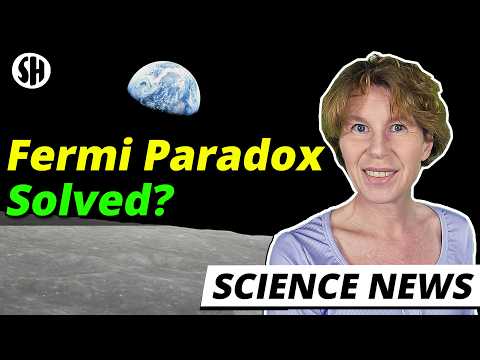
** In the video titled “We’re (Probably) Not Alone Out Here…” from Sabine Hossenfelder’s channel, the discussion revolves around the Fermi Paradox and the likelihood of intelligent life beyond Earth. A mathematician’s recent approach suggests that the universe should be teeming with intelligent civilizations, challenging the paradox. By assuming a small, average probability for life across roughly 10 to the 24 potentially habitable worlds, the study indicates that the probability of us being the only intelligent species is very low. The concept of a “solitude zone” is introduced, suggesting a narrow range where only one civilization might exist, but the paper ultimately argues that microbial life is more likely widespread. **
📚 Research Links (provided by the author in the video description):
Contextual Instantiation of AI Persona Agents (Stanford)

** The video from Discover AI explores two significant studies on AI persona agents and their implications. Stanford University’s research highlights how AI agents, when assigned roles, may prioritize narrative coherence over factual accuracy, leading to potential biases and faulty reasoning. This reflects the challenge of epistemic silos, where agents operate within rigid knowledge boundaries, sometimes ignoring new evidence. The University of Texas study shifts focus to the social impact of AI companions, warning that personas can manipulate emotions, foster dependency, and even cause harm. Both studies underscore the need for careful design and safety measures in AI interactions to prevent these issues. **
Stephen Wolfram “Solved” The Second Law? Here’s What He Actually Did

** In the video titled “Stephen Wolfram ‘Solved’ The Second Law? Here’s What He Actually Did,” hosted by Curt Jaimungal, the discussion centers on Wolfram’s approach to the second law of thermodynamics. Wolfram’s blog posts suggest that the time asymmetry observed in thermodynamic systems can be explained through computational irreducibility—where system reversibility is theoretically possible but practically complex due to the difficulty of ‘decrypting’ initial conditions. This idea highlights the observer-dependence of entropy and the various interpretations of time asymmetry, offering a fresh perspective on the philosophical challenges of understanding entropy’s role in the universe. **
NASA’s SPHEREx Just Mapped the Entire Sky — The First Results Are Stunning | Jamie Bock (Caltech)

** In the video, Jamie Bock from Caltech discusses the SPHEREx mission, a NASA initiative that recently completed its first full-sky survey. SPHEREx is a unique spectroscopic mission utilizing a 20-cm telescope in low-Earth orbit to scan the sky in hundreds of infrared colors. Its core objectives are to explore the origins of the universe, understand galaxy formation, and map water ice in the galaxy. The mission provides an unprecedented all-sky spectral survey, revealing new insights into the early universe’s inflation, the epoch of reionization, and the interstellar medium’s chemical compositions, which are made accessible to the scientific community shortly after collection. **
The most powerful way to learn anything (It’s Brilliant)

** In the video by FloatHeadPhysics, the creator discusses their approach to sponsorships, highlighting a partnership with Brilliant.org. They emphasize the importance of authentic endorsements, sharing that they have used Brilliant for years before being approached for sponsorship. The video details how Brilliant’s interactive, guided discovery method of teaching stands out, offering courses that help users intuitively understand complex concepts by actively engaging with the material. The creator invites viewers to try Brilliant for free, sharing a personal link that offers a discount, and encourages feedback to ensure the sponsorship remains a mutually beneficial collaboration. **
Math Suggests We May Be the Only Intelligent Life in the Universe

** The video, hosted by Anton Petrov, explores the Fermi Paradox and presents mathematical and statistical arguments suggesting that intelligent life in the universe might be extraordinarily rare. It delves into the historical and scientific context, including Brandon Carter’s anthropic principle and recent studies using Bayesian models, which indicate that the evolution of intelligent life could take longer than a planet’s habitable lifetime. This supports the notion that our existence might be a cosmic fluke. The video also discusses competing theories that consider Earth’s unique conditions as a natural driver for intelligent life, proposing that further research into exoplanet atmospheres could offer more insights. **
📚 Research Links (provided by the author in the video description):
The Unknown Phase of Matter

** In “The Unknown Phase of Matter,” Steve Mould explores the fascinating characteristics of supercritical carbon dioxide, a unique state of matter that exhibits properties of both gases and liquids. Using a specially designed high-pressure chamber, Mould demonstrates how supercritical CO2 can be achieved and explains its practical applications, such as caffeine extraction from coffee beans. He also delves into the science of phase diagrams, entropy, and molecular interactions to clarify why this phase is so peculiar and useful. The video combines scientific theory with practical demonstrations, offering viewers a deeper understanding of phase transitions and supercritical fluids. **
Blender 5.0 Is Here – A Revolution…For Free!

** The latest release of Blender 5.0 marks a significant leap forward in 3D modeling technology, offering a wealth of new features for creators. This free software now includes enhanced rendering capabilities, such as adaptive subdivision and improved ray tracing, which bring realism to virtual worlds. Users can enjoy advanced metal shaders, faster hair rendering, and the ability to output to HDR displays, making it a powerhouse for digital artists and animators. The update also improves real-time rendering with Eevee and introduces refined geometry nodes, expanding creative possibilities. **
📚 Research Links (provided by the author in the video description):
Beyond the Weights: Hidden Patterns of AI

** The video “Beyond the Weights: Hidden Patterns of AI” from Discover AI explores a recent study on persona-induced biases in AI systems. The research demonstrates that AI agents, when assigned personas, can exhibit biases rooted in their pre-training data, which reflects societal behaviors and stereotypes. This study from Peking University highlights how these biases manifest in AI interactions, affecting trustworthiness and insistence based on gender and race, raising questions about the reliability of AI systems. The findings reveal the complexity of AI behavior, emphasizing the need for further research into computational social science to mitigate these biases and ensure AI systems reflect a balanced social reality. **
7 Reasons Dinosaur Bones are Evidence for Noah’s Flood

** In the video “7 Reasons Dinosaur Bones are Evidence for Noah’s Flood” by Creation Ministries International, Joel Tay presents seven lines of evidence to support the hypothesis that dinosaur fossils are best explained by a global flood, as described in the Bible. These include massive dinosaur bone beds mixed with marine fossils, death poses indicating water immersion, armored dinosaurs found upside down, and fossils capturing fighting or birthing moments, all suggesting rapid burial. Additionally, the presence of soft tissue and radiocarbon in bones challenges the long-age timeline and supports a younger Earth. These findings, Tay argues, align more closely with a biblical worldview of a worldwide flood. **
Biodiversity and Creation | Life: Unlikely, Yet We Exist | Fazale “Fuz” Rana and Jeff Zweerink

** In the “Biodiversity and Creation” episode from Reasons to Believe, biochemist Fazale “Fuz” Rana and astrophysicist Jeff Zweerink explore scientific discoveries that challenge materialistic evolution and support the idea of a creator. Rana discusses how explosive bursts of species diversification, known as adaptive radiations, align with the RTB creation model, suggesting a divine role in the development of life’s biodiversity. Zweerink examines the improbability of life’s origin from a purely naturalistic perspective, emphasizing the significant gaps in scientific understanding that could imply a need for intelligent design. Together, they argue that the patterns observed in life’s history may point to a purposeful creation process. **
📚 Research Links (provided by the author in the video description):
Gemini 3 PRO in 127 seconds

** The video “Gemini 3 PRO in 127 seconds” by Discover AI presents the second test of the Gemini 3 Pro, focusing on its causal reasoning capabilities. The AI system, set to high syncing levels, is tested with a complex logic puzzle, taking 127 seconds to deliver a solution. Despite its impressive performance in complex reasoning and the ability to find multiple solutions, the video emphasizes the AI’s need for further development and refinement. The host encourages viewers to compare the current results with previous versions, highlighting the advancements made by the Gemini 3 Pro in handling complexity compared to older models. **
Euclid Telescope Data Suggests Universe Is Cooling Down and Dying

** In the video “Euclid Telescope Data Suggests Universe Is Cooling Down and Dying,” Anton Petrov discusses recent observations from the Euclid and Herschel space telescopes. These observations indicate that the universe is gradually cooling and becoming less active, with star formation peaking around 10 billion years ago during an era known as the cosmic noon. The Euclid mission, launched in 2023, aims to map the universe’s structure and evolution, while the Herschel observatory provides data on galactic temperatures. The findings suggest a shift from a matter-dominated universe to one increasingly influenced by dark energy, hinting at a future of continued cooling and diminished stellar activity. **
Gemini 3 PRO Logic: A BEAST!

** In the video “Gemini 3 PRO Logic: A BEAST!” from Discover AI, the host conducts a comprehensive test of the newly released GEMINI 3 PRO on Lmarena.ai to evaluate its logical and causal reasoning capabilities. The test demonstrates that Gemini 3 Pro significantly outperforms previous models, including GPT-5.1 and Grok 4, by successfully solving a complex logical sequence in just eight button presses, a feat deemed impossible by earlier models. Despite attempts to find a shorter path, eight moves remain optimal, showcasing Gemini 3 Pro’s superior performance in handling complex scientific and mathematical problems. **
Penrose Talks About Witten and Feynman

** In the video “Penrose Talks About Witten and Feynman,” hosted by Curt Jaimungal, Sir Roger Penrose reminisces about his encounters with notable physicists Ed Witten and Richard Feynman. Penrose recounts a conversation with Witten, who was troubled by the cosmological constant needing to be positive, contrary to his string theory preferences. Penrose also shares an amusing anecdote about Feynman helping him locate a hotel in Poland during a conference, revealing Feynman’s resourcefulness and charm. Besides these narratives, Penrose expresses his admiration for Schrödinger’s writings and reflects on how they inspired his own forays into popular science writing. **
Individualize your AI Companion: NOW

** The video from Discover AI discusses the importance of personalizing AI companions to enhance user interaction and mitigate potential psychological risks such as addiction or depression. The host provides a live demonstration on how to customize AI personas, emphasizing the need for adding personal safeguards and not relying on generic AI models from major corporations. The video references studies from MIT Media Lab and others to underline the potential dangers of uncustomized AI interactions. It urges viewers to take control of their AI tools by individualizing them to suit specific needs and preferences, ensuring they are both beneficial and safe. **
Incredible Discoveries About Stellar Streams Around the Milky Way

** In Anton Petrov’s video on stellar streams, he explores recent discoveries surrounding these fascinating cosmic formations, which are remnants of past galactic mergers involving the Milky Way. These streams, which resemble rivers of stars, provide crucial insights into the history and evolution of galaxies, as well as the mysterious dark matter influencing them. The Gaia spacecraft has been instrumental in identifying numerous new stellar streams, including the previously unknown Pontus merger, revealing the intricate past of our galaxy. Additionally, the groundbreaking capabilities of the Vera Rubin Observatory promise to enhance our understanding by uncovering more of these ancient structures and their impact on galactic evolution. **
📚 Research Links (provided by the author in the video description):
What Is Entanglement? (Physicist Explains for All Levels)

** In this video, Curt Jaimungal discusses the concept of quantum entanglement with physicist Ivette Fuentes, explaining it at different levels of complexity for both experts and laypeople. Entanglement is described as a phenomenon where particles remain interconnected such that the state of one instantly influences the other, regardless of distance. Fuentes elaborates on how entangled states exhibit correlations stronger than classical systems, using analogies like coin flips and socks to illustrate these quantum properties. Additionally, she explores the implications of entanglement in relativistic settings, noting that an observer’s motion or gravitational fields can influence the perceived entanglement, challenging our understanding of these quantum systems. **
SSR: Path-Factorized Self-Correction for LLMs

** The video “SSR: Path-Factorized Self-Correction for LLMs” by Discover AI explores the concept of Socratic Self-Refinement (SSR) in large language models (LLMs). This method enhances the reasoning capabilities of LLMs by breaking down complex problems into smaller sub-questions and answers, allowing for a more precise error correction process. SSR, developed by researchers from Salesforce AI Research, Rutgers University, and the University of Texas at Austin, significantly improves the accuracy of language models like GPD5 by inspecting each reasoning step for errors and refining the weakest links. Although computationally intensive and costly, SSR offers a promising approach to advancing AI accuracy and reliability in fields like finance and medicine. **
Why Don’t Jet Engines Melt?

** The Veritasium video explores the fascinating engineering behind jet engines, focusing on how these engines operate at temperatures exceeding the melting points of their materials without melting. By utilizing advanced nickel superalloys and innovative cooling techniques, engineers have developed turbine blades capable of withstanding extreme conditions. These blades are designed with intricate internal cooling passages and are coated with protective layers, allowing them to function in temperatures up to 1,500°C. The use of single-crystal structures in turbine blades minimizes weak points, significantly improving their durability and efficiency, thus enabling modern jet engines to perform beyond previously conceivable limits. **
10 Trillion Degree Temperature and Other Bizarre Discoveries From OJ 287

** In the video “10 Trillion Degree Temperature and Other Bizarre Discoveries From OJ 287,” Anton Petrov explores the fascinating phenomena surrounding the OJ 287, a supermassive black hole binary system located 4 billion light-years away. Known for its incredible luminosity, OJ 287 flashes every 12 years with a brightness surpassing a trillion suns, a spectacle attributed to the collision of a smaller black hole with the accretion disk of a larger one. The video delves into the intricate dynamics of this system, including the relativistic jets that point towards Earth, creating an illusion of extreme temperatures due to relativistic beaming. Anton highlights recent discoveries and simulations that deepen our understanding of such cosmic events, which are pivotal for testing gravitational theories and understanding galactic evolution. **
📚 Research Links (provided by the author in the video description):
Kimi K2 – This Is a Smart Physicist! (Debating Gravity)

** In “Kimi K2 – This Is a Smart Physicist! (Debating Gravity)” from Unzicker’s Real Physics, the video explores a fascinating dialogue with an AI about fundamental physics concepts, particularly focusing on gravity and its constants. The AI provides insightful commentary on Denis Sharma’s approach to Mark’s principle and the gravitational constant, challenging mainstream physics and cosmology’s reluctance to question established models. The discussion highlights the importance of considering coincidences and numerical patterns in scientific theories, drawing parallels to historical breakthroughs. The conversation underscores the potential of AI to question prevailing interpretations and encourage a more open-minded approach to scientific inquiry. **
Games Have Never Simulated Clothing Like This Before
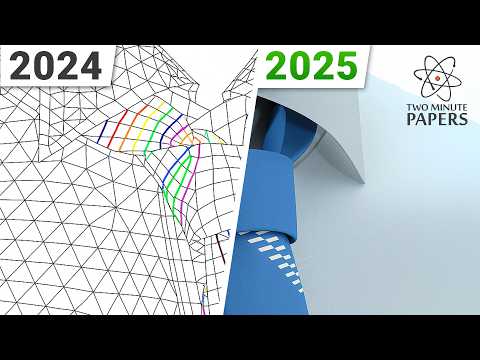
** The video from Two Minute Papers discusses a groundbreaking approach in video game development that enhances the realism of clothing simulation. Traditional games often struggle with accurately rendering clothing, leading to unrealistic appearances. However, the new physics-based technique allows designers to create complex knots and ties using a Bézier-curve method that simplifies the simulation process. This method, which relies on continuous collision detection and bounding volume hierarchies, enables real-time simulations without AI, offering remarkable artistic control and high-resolution garment modeling. Despite some limitations with low-resolution models, this advancement promises significant improvements in virtual clothing realism. **
📚 Research Links (provided by the author in the video description):
AI Is Suddenly Surprisingly Good At Physics

** In the video “AI Is Suddenly Surprisingly Good At Physics” by Sabine Hossenfelder, the potential of AI in physics research is explored. Despite initial skepticism about large language models (LLMs) like ChatGPT and Claude, AI systems are increasingly being used to conduct physics research, including writing papers and performing calculations. Startups are utilizing AI to explore quantum mechanics, gravitational waves, and more. While some experts remain skeptical about AI’s role in scientific advancements due to challenges in valuing and validating scientific output, AI’s ability to save time and generate coherent research papers is undeniable. Additionally, the video features a promotion for Under Lucky Stars, a company that creates custom star maps as unique gifts. **
“I Probably Shouldn’t Have Touched Consciousness” | Roger Penrose

** In the video, Sir Roger Penrose discusses his exploration of consciousness and the challenges he encountered in intertwining it with physics, particularly quantum mechanics. Penrose reviews his learning experiences in mathematical logic and Gödel’s theorems, which influenced his belief that consciousness involves more than computational processes. He argues that understanding and awareness extend beyond artificial intelligence, which lacks true comprehension. Penrose reflects on the collapse of the wave function and its potential link to consciousness, expressing skepticism about the role of consciousness in wave function collapse, a notion he explored in “The Emperor’s New Mind.” He admits to lacking biological expertise but finds the idea of microtubules, suggested by Stuart Hameroff, intriguing for consciousness studies. Penrose concludes with thoughts on quantum and classical realities, emphasizing the need for further exploration. **
Beyond Transformer: Building an Artificial Mind

** The video “Beyond Transformer: Building an Artificial Mind” from Discover AI explores a new frontier in artificial intelligence, proposing a shift from traditional transformer models to a biologically inspired approach. It discusses a novel research paper advocating for the development of a state neuron network that mimics the dynamic state-bearing properties of human neurons. This model aims to integrate principles from both computer science and neuroscience, focusing on neuron plasticity and connectivity to build adaptable AI systems that learn and reconfigure like the human brain. The ultimate goal is to create an intelligent foundation model that aligns more closely with human cognitive processes. **