

Weekly Physics Digest – August 16 – August 22, 2026
This Week’s Digest: The Cosmic Dance of Science and Curiosity! Welcome to another week of mind-bending exploration! We’ve got a lineup that’s as eclectic as a mad scientist’s lab, featuring everything from the mysteries of the universe to the peculiarities of everyday household items. If you’re intrigued by the concept of new universes forming inside dying stars, check out our standout video *New Universes Can Form Inside Dying Stars, Physicists Show!*, a delightful theoretical romp that challenges our understanding of black holes. And if you’ve ever wondered how a smoke detector relates to cosmic rays, Dr. Brian Keating has the answer! Learn fast, stay curious!
This Scientist Found Earth’s “Alien” Minds

** In the video “This Scientist Found Earth’s ‘Alien’ Minds,” Curt Jaimungal interviews Peter Godfrey-Smith, a philosopher and scientist, who explores the consciousness of octopuses and other cephalopods. Godfrey-Smith argues that octopuses may represent the closest encounter humans have with alien intelligence due to their significant evolutionary divergence from us, complex behaviors, and potential for consciousness. He discusses the nuances of defining mind, consciousness, and selfhood, proposing that these concepts exist on a spectrum rather than as binary classifications. The conversation also delves into the unique neural structure of octopuses, which suggests a decentralized form of intelligence, challenging traditional notions of what it means to have a mind. **
📚 Research Links (provided by the author in the video description):
This Device Goes Past Equilibrium

** In “This Device Goes Past Equilibrium,” Steve Mould explores the fascinating concept of counterflow heat exchangers, which allow two liquids to exchange heat in a way that can lead to surprising temperature results. Using a practical demonstration with colored liquids, he illustrates how the cold liquid can end up hotter than the initial hot liquid, defying intuitive expectations while adhering to the second law of thermodynamics. Mould explains the mechanics behind this process, detailing its applications in various industries, from home brewing to pasteurization, and even in nature, such as in bird feet. He concludes by highlighting the prevalence of counterflow structures in diverse fields, including finance, and encourages viewers to consider their own observations of such patterns in everyday life. **
God’s Providence and the Effects of Radiation on the Human Body

** In the video “God’s Providence and the Effects of Radiation on the Human Body,” astrophysicist Hugh Ross and physicist Hugh Henry explore the surprising benefits of low-level radiation, challenging the conventional belief that all radiation is harmful. They discuss the findings from the 2015 Nobel Prize in Chemistry, which revealed that radiation can aid in DNA repair, thus promoting health. The conversation highlights the importance of God’s providence in human existence, suggesting that our position in the Milky Way exposes us to beneficial cosmic radiation while protecting us from harmful levels. Through various studies, including those involving mice and historical radiation events, they demonstrate that low radiation can stimulate biological functions and repair mechanisms, offering a fresh perspective on the relationship between radiation and health. **
Are There Limits To What Physics Can Explain? | World Science Festival

** In this thought-provoking conversation, Brian Greene and Marcelo Gleiser explore the boundaries of physics, philosophy, and human understanding. They discuss the emergence of life from simple chemistry, the philosophical implications of mortality, and the mystery surrounding consciousness. Gleiser reflects on the significance of human creativity and our innate desire to comprehend existence, while both thinkers ponder the potential limitations of our knowledge in the face of complex phenomena. Ultimately, they emphasize the importance of embracing uncertainty and the transformative power of inquiry in a universe that is far from fully understood. **
There are no rules in science
** In “There Are No Rules in Science,” The Last Theory challenges the conventional belief that scientific theories must adhere to strict rules. The speaker argues that many groundbreaking theories, from Copernicus to quantum mechanics, defied established norms and ultimately reshaped our understanding of the universe. The video emphasizes that the only essential guideline in science is to “say something interesting about the real world,” suggesting that clinging too tightly to rules can stifle creativity and innovation. By advocating for a more open-minded approach, the video encourages viewers to embrace unconventional ideas that may lead to significant discoveries. **
Total Solar Eclipse From Space

** In the Veritasium video titled “Total Solar Eclipse From Space,” viewers are taken on a journey to Spain to witness the 2026 total solar eclipse from the edge of space. The hosts collaborate with NASA to explore the science behind eclipses, addressing fascinating questions such as why the Northern Hemisphere experiences more total eclipses and the mysterious shadow bands observed during such events. Through engaging experiments and insights from experts, the video highlights the unique phenomena observed during eclipses, including the sudden change in sunlight color and the significance of eclipse seasons. The experience culminates in a breathtaking view of the eclipse, leaving the hosts and viewers in awe of this natural spectacle. **
JWST’s Little Red Dots Are Even Stranger Than Predicted

** In this video, Anton Petrov explores the mysterious “Little Red Dots” (LRDs) discovered by the James Webb Space Telescope, which appear shortly after the Big Bang but vanish within a billion years. Initially thought to be massive galaxies, new studies suggest they may represent exotic objects like supermassive black holes or even forming globular clusters. The V-shaped spectrum of these objects raises questions about their origin, with hypotheses ranging from massive stars to different types of celestial formations. The discussion highlights the implications of these findings for our understanding of the early universe and the formation of astronomical structures. **
📚 Research Links (provided by the author in the video description):
Breakthrough: New Type of Matter Discovered

** In a groundbreaking discovery, scientists have identified a new type of matter within a cooled ferroelectric crystal, where domains spontaneously form a three-dimensional woven structure at room temperature. This unique pattern can be altered with a laser, paving the way for potential applications in memory storage and neuromorphic computing. While this discovery is still in its early stages and requires further research, it represents a significant leap in material science and may lead to revolutionary advancements akin to previous Nobel Prize-winning materials like quasicrystals. **
📚 Research Links (provided by the author in the video description):
Maxwell’s Demon of AI: How API Proxies Tame RL State-Space Chaos

** In the video “Maxwell’s Demon of AI: How API Proxies Tame RL State-Space Chaos,” the host discusses the challenges of using reinforcement learning (RL) with agents constrained by proprietary software harnesses. These harnesses complicate the RL process by obstructing direct communication with the environment, leading to a breakdown in traditional RL mathematics. The video explores a potential solution through the use of API proxies, which can facilitate communication between the RL trainer and the agent without requiring modifications to the harness. However, it also reveals that the introduction of a proxy can disrupt the linearity of data needed for effective RL, leading to unexpected results and errors in training. **
📚 Research Links (provided by the author in the video description):
The Secret Physics Inside A Smoke Detector

** In this captivating video, Dr. Brian Keating explores the intriguing physics behind smoke detectors and their connections to groundbreaking scientific experiments. He meticulously dissects a Geiger counter and a multi-million-dollar muon g-2 experiment, revealing how both are designed to detect different types of radiation and fundamental particles. The video explains how muons—unstable particles created from cosmic rays—defy classical physics by reaching the Earth’s surface despite their short lifespan, highlighting the principles of relativity. Through engaging demonstrations, Keating illustrates the broader implications of these particles, emphasizing how our understanding of the universe is deeply intertwined with everyday technologies like smoke detectors. **
Life from Dead Chemicals? You Must Be Joking!

** In the video “Life from Dead Chemicals? You Must Be Joking!”, industrial chemist Dr. Stephen Grocott argues against the notion that life can spontaneously arise from non-living chemicals, emphasizing the necessity of a purposeful design. He uses analogies and scientific principles to illustrate that complex biological molecules, such as proteins and nucleic acids, cannot form through chance due to immense improbabilities and destructive forces like water. Grocott highlights the intricacies of molecular chirality and the failure of random combinations to yield functional life forms, ultimately advocating for a designer behind life’s origins. His insights challenge the prevailing belief in spontaneous abiogenesis by showcasing the overwhelming scientific evidence for intentional creation. **
Studies Change Our Perspective on the Evolution of Milky Way Galaxy

** In this video, Anton Petrov explores recent discoveries about the Milky Way galaxy that challenge long-held assumptions about its formation and evolution. Using data from advanced telescopes like Gaia and the James Webb Space Telescope, scientists now understand that the Milky Way is not a static object but a dynamic, chaotic system shaped by a series of galactic collisions and mergers over billions of years. Key findings reveal that the galactic disk likely formed earlier than previously thought, and various ancient star groups indicate multiple accretion events rather than a singular major merger. These insights suggest that the galaxy is still evolving, with ongoing interactions with neighboring galaxies, thereby continually reshaping its structure. **
New Universes Can Form Inside Dying Stars, Physicists Show
** In her video, Sabine Hossenfelder explores the intriguing hypothesis that new universes can form inside collapsing stars, challenging traditional notions of black holes. By examining a recent paper that offers a novel solution to Einstein’s equations, Hossenfelder explains how collapsing matter can expand internally, avoiding the formation of a black hole and potentially giving rise to a new universe. While this idea has been speculated upon since the 1970s, she emphasizes that while mathematically sound, the physical plausibility remains uncertain, and it is one of many theories without observational evidence to support it. **
📚 Research Links (provided by the author in the video description):
Engineering Chair: Most People Should Not Go To College

** In the video “Engineering Chair: Most People Should Not Go To College,” Dr. Brian Keating interviews Darren Leone, Chair of Chemical and Sustainability Engineering at the University of Rochester. Leone argues that the traditional four-year college model is not suitable for most individuals due to the high cost of education and the low likelihood of securing a tenure-track position in academia. He emphasizes the need to focus on vocational training and hands-on skills, suggesting that many graduates could find fulfilling careers without a degree. The discussion also touches on the evolving role of academia, metrics for evaluating researchers, and the importance of mentorship in a challenging job market. **
Alien Spacecraft Are On the Moon, Astronomers Claim. Seriously now?

** In this video, Sabine Hossenfelder examines a recent claim by astronomers who assert they have detected over twenty giant unidentified objects near the Moon, some measuring up to 40 kilometers across. While the Daily Mail sensationalized this finding, Hossenfelder critically analyzes the lack of credible evidence, pointing out that the observations were made using a low-resolution telescope and are likely misidentified dust rather than extraterrestrial spacecraft. She discusses historical reports of anomalous light phenomena observed by Apollo astronauts and suggests the importance of separating moon anomalies from general UAP sightings to facilitate a more focused investigation. Hossenfelder concludes by proposing that while the search for alien artifacts on the Moon has yet to be undertaken, it remains a fascinating area for future exploration. **
Two Dimensions of Time Explain Quantum Physics, Physicist Argues

** In this video, physicist Robert Nemiroff presents a groundbreaking idea that could explain the perplexities of quantum physics: the existence of two dimensions of time. He mathematically demonstrates that quantum entanglement, which is often seen as “spooky action at a distance,” might be a result of this second time dimension, allowing particles to instantaneously update their properties without violating the laws of physics. Nemiroff proposes an experiment to test this theory, which could reveal an additional correlation between entangled particles, challenging traditional quantum mechanics. Although the concept presents several unresolved issues, it opens a new avenue in the quest to understand the underlying principles of quantum phenomena. **
📚 Research Links (provided by the author in the video description):
The Strangest Asteroid Shape That Shouldn’t Exist (44 Nysa)
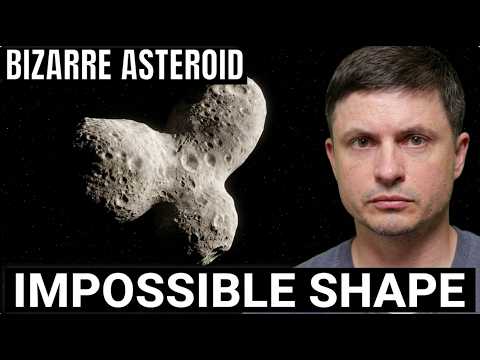
** In the video “The Strangest Asteroid Shape That Shouldn’t Exist (44 Nysa),” Anton Petrov explores the recent discoveries surrounding the asteroid 44 Nysa, which has an unusual shape that challenges existing asteroid formation models. Unlike typical asteroids, which are often considered simple, lumpy objects, Nysa exhibits a complex, trinary structure resembling a ginger root. This discovery raises questions about its formation, with possible explanations including a hit-and-run collision or slow merging of three separate bodies. Additionally, the presence of a small moon orbiting Nysa adds to its intrigue, making it a prime subject for future astronomical studies and potentially shedding light on the building blocks of planets. **
📚 Research Links (provided by the author in the video description):

